An open source CMDB, and so much more
A CMDB is a core component in any Asset Management strategy, offering a structured and centralized way to collect, organize and maintain information about the assets of an organization and the relationships among them.
Although its origins lie in the IT domain through the ITIL framework, the CMDB concept extends naturally to any context where assets must be tracked, controlled and understood throughout their lifecycle.
The following sections describe what a CMDB is, which types of assets it can manage, the questions it helps answer and the benefits it provides when introduced within a structured organizational framework.
What is a CMDB
A CMDB (Configuration Management Database) is a storage and consultation system used to manage asset information within an organization. Originally conceived in the IT domain — it is a key component of the ITIL best practice framework (Information Technology Infrastructure Library) — the CMDB model can be applied in any context where assets must be known, managed and controlled.
It is the official central repository that provides a consistent view of the items to be managed. A CMDB is a dynamic system that represents the current situation and knowledge of the asset inventory and its relationships.
What kind of assets can a CMDB manage
- Information assets: hardware (computers, peripherals, networking, telephone equipment), software (system, middleware, applications), user services and other internal or external resources
- Assets related to properties (buildings, plants, technical devices, furniture)
- Assets related to manufacturing plants (factories, plants, machinery)
- Other types of assets (vehicles, electro-medical equipment, etc.)
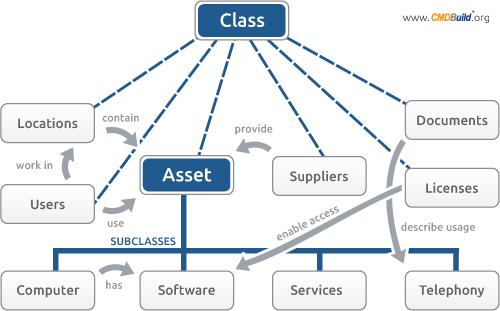
Questions the CMDB answers
- Where is an asset or CI (Configuration Item)?
- Who uses it?
- What does it belong to?
- What is it made up of?
- What and where are other similar CIs?
- What has happened during the CI life cycle?
- Which CIs are affected by a potential change?
- Which activities require my intervention?
- How much does CI management cost?
- Which assets require specific assistance?
- What is the status of CI data compilation?
- What are the intervention SLAs for CI-related requests?
- What are the KPI values that evaluate organizational performance?
Why use a CMDB
Using a CMDB enables control over managed assets, knowing at all times their composition, location and functional relationships.
Missing or outdated information causes unnecessary costs, redundant operations, delays in problem resolution and obstacles to company activities.
Keywords for a CMDB are response time and system control.
A CMDB — for any type of Asset Management application — allows to:
- reduce problems in the infrastructure
- solve remaining problems more rapidly
- increase the percentage of issues resolved at first contact, limiting the involvement of expert staff
- keep track of every data-change operation
- maintain a repository of statistical data useful for SLA verification
In other words, costs decrease and service quality improves.
Implementation guidelines
Introducing an application for asset management must be properly prepared in terms of organization and training to reduce the risk of failure or resistance to adoption.
When managing the project, it is important to:
- adopt guidelines aimed at gradual and flexible implementation
- choose a level of detail consistent with organizational needs and available human, financial, informational and technological resources (if the system is extensible and modular, it is preferable to extend the data model over time rather than overload the initial schema)
- introduce the application within an organizational framework based on clear responsibilities, procedures and roles
A successful project must consider the impacts and changes introduced by the system and must obtain explicit approval from the organization’s management.
Open Source
Open source is better. An open source solution allows to:
- avoid high licensing fees
- access the source code, reducing dependency on the supplier
- ensure greater freedom of use in different locations and for various needs
- reuse evolutionary features developed on demand by other users
- collaborate with a community that shares experience on organization and implementation (data model, processes, etc.)
An open source solution is not free of charge — external services and internal activation costs remain — but authoritative sources consistently report a lower total cost of ownership (TCO, Total Cost of Ownership).
An open source product is not necessarily a good product, but the software landscape now offers many open source solutions that are technologically advanced and better supported than proprietary alternatives. Open source components integrated or interoperable with CMDBuild are selected among the most complete, widespread and mature.
Not only a CMDB
Despite its name, CMDBuild is not only a modeling environment for CMDB applications limited to the management of a database of Configuration Items.
CMDBuild mechanisms allow you to manage CIs and their usage conditions throughout the entire life cycle: processes, business rules, documents, reports, georeferencing, interoperability with other systems and more.
In the IT Service Management domain as described in ITIL — and implemented in the CMDBuild READY2USE vertical solution — CMDBuild is not only a CMDB (Configuration Management Database) system, but a CMS (Configuration Management System). ``